


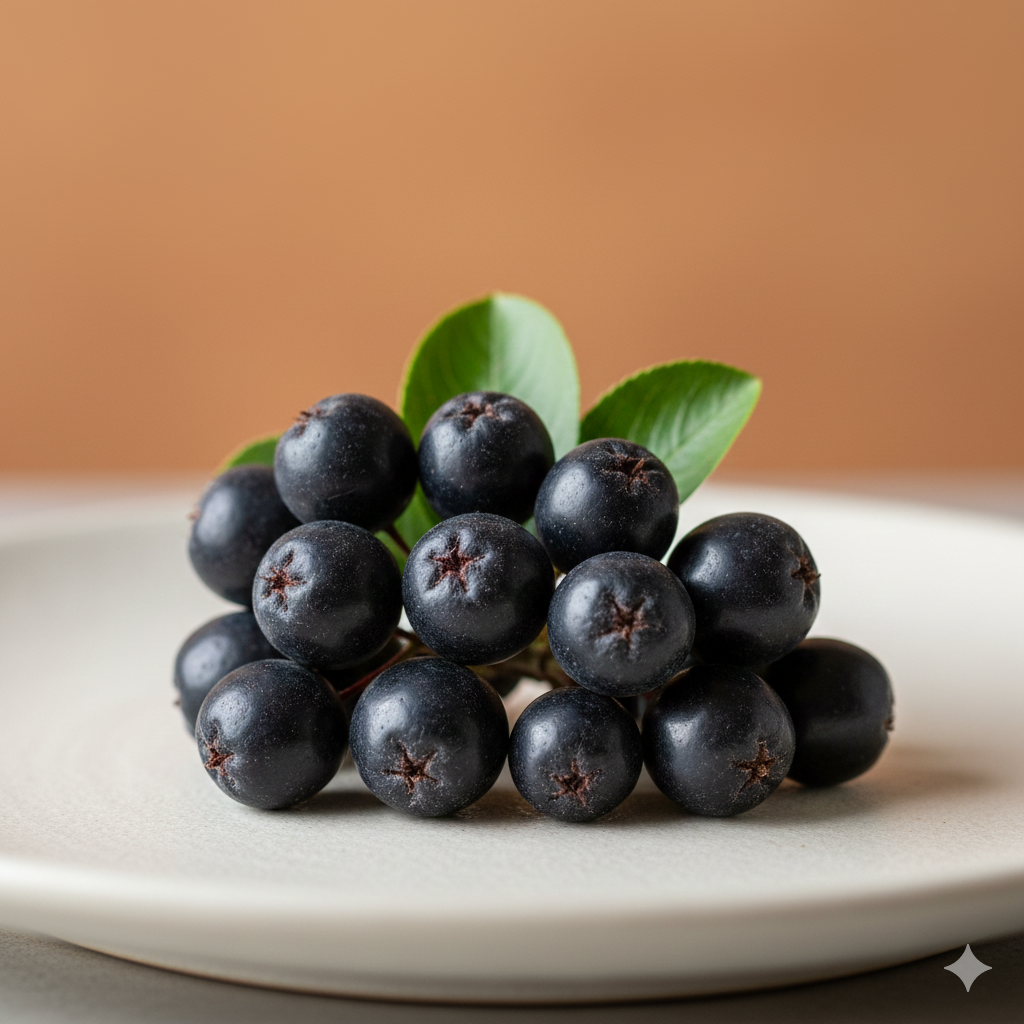
These days, aronia has been attracting my attention on the market shelves with its unusual name and its blackish purple color similar to blueberries. It must be the selectivity in perception, but recently, I started to notice posts on the internet such as “super fruit aronia”. When I examined these posts a little more, I realized that this “super” fruit is said to be able to prevent cancer and even cure cancerous cells.
Is aronia really a cure for cancer? And more importantly, is there really such a thing as a superfood?
Research on aronia is limited
Aronia attracts attention due to its antioxidant properties according to the results obtained from animal experiments. The polyphenols it contains have the potential to prevent cell damage by neutralizing free radicals in the body.
There is research that aronia can slow cell growth in some types of cancer. For example, in one study, aronia extract was found to slow the development of colon cancer in mice. In another 2012 study, aronia extracts were observed to reduce cell damage in people with breast cancer. However, since these studies are still in the early stages, it is not certain whether the same effect will be seen in humans.
In short: Aronia extract may have a cell-protective effect, but we don’t yet know whether this applies to humans. So, human studies are needed to understand the relationship between aronia and cancer prevention.
So why are animal or laboratory experiments alone not enough? Because although these experiments are promising, it is not certain that they will have the same effect in humans. Just because a substance shows “anti-cancer” properties in the laboratory does not mean that it will work in the human body. The human body is very complex; many factors come into play, such as how the substance will be absorbed, what dose will work, how it will affect the immune system.
Food doesn’t have to be “super”
In fact, there is no such thing as a “superfood” or a “superfruit” . We don’t need to label foods with adjectives like “super” anyway. Fruits and vegetables should be in our lives not because they prevent cancer or because they are “superfoods”, but because they are good sources of vitamins and fiber. This is the cornerstone of a balanced diet.
It is known that eating a healthy and balanced diet can help reduce the risk of cancer. However, no single nutrient alone can prevent or treat cancer. Especially red fruits such as aronia, blueberries, açai and strawberries are thought to prevent or treat cancer due to their antioxidant properties, but there is no scientific evidence to support these claims.
“Superfood” is a marketing tool
However, scientists believe that the use of the term “superfood” is largely a marketing tool. Today, you can see aronia being sold as an anti-cancer fruit on popular online shopping websites.
As a matter of fact, the term originated not from nutritionists, but from advertising strategies. During World War I, the United Fruit Company launched a massive advertising campaign to sell bananas, its main product. The brochures used the term “superfood” to describe bananas as cheap, nutritious, easily digested and ubiquitous.
Exaggerated labels such as “super” can mislead consumers into thinking that they can eat unlimited amounts of these foods because they are unscientific and unquantifiable. However, as with everything else, we need to consume a certain amount of food in order for it to benefit our bodies.
Psychologically, the search for a ‘miracle’ food can lead to neglect of healthy habits. Even worse, a person who thinks that with a good enough marketing tactic they can cure cancer with aronia or some other “superfood” may turn away from the scientific treatment recommended by their doctor.
The important thing is to know your limits
This claim is an example of the illusion of certainty. That is, methods that have not yet been proven to be effective are presented as if they give definitive results, and persuasion is sought through fancy expressions rather than scientific evidence.
Today’s findings are promising, but not yet a “cure”.
If you are undergoing cancer treatment or if you think it will support the treatment of a relative, there is no harm in consuming aronia in consultation with your doctor and in moderation. However, do not expect a miracle while consuming this fruit; at least until extensive research is done, it is necessary to know that aronia alone will not cure cancer.
Sources
- PubMed Central (PMC) — “Aronia melanocarpa Products and By-Products for Health and Nutrition: A Review”, 2021-06-28. Open source
- ScienceDirect — “study”. Open source
- ScienceDirect — “study”. Open source
- PubMed Central (PMC) — “Reality check: no such thing as a miracle food”, 2013-01-01. Open source
- Cancerresearchuk — “Does a healthy diet reduce cancer risk? | Cancer Research UK”. Open source
- Cancerresearchuk — “Food myths | Cancer Research UK”. Open source
- ScienceDirect — “believe”. Open source
- The Nutrition Source - Harvard Chan School — “Superfoods or Superhype? • The Nutrition Source”, 2018-03-20. Open source

 Öyküm Hüma Keskin
